How to Play Mines: Rules, Odds, Multipliers and Strategy
Learn how to play the mines game: picking tiles on a 5x5 grid, choosing a mine count, exact odds per pick, how multipliers work and when to cash out.
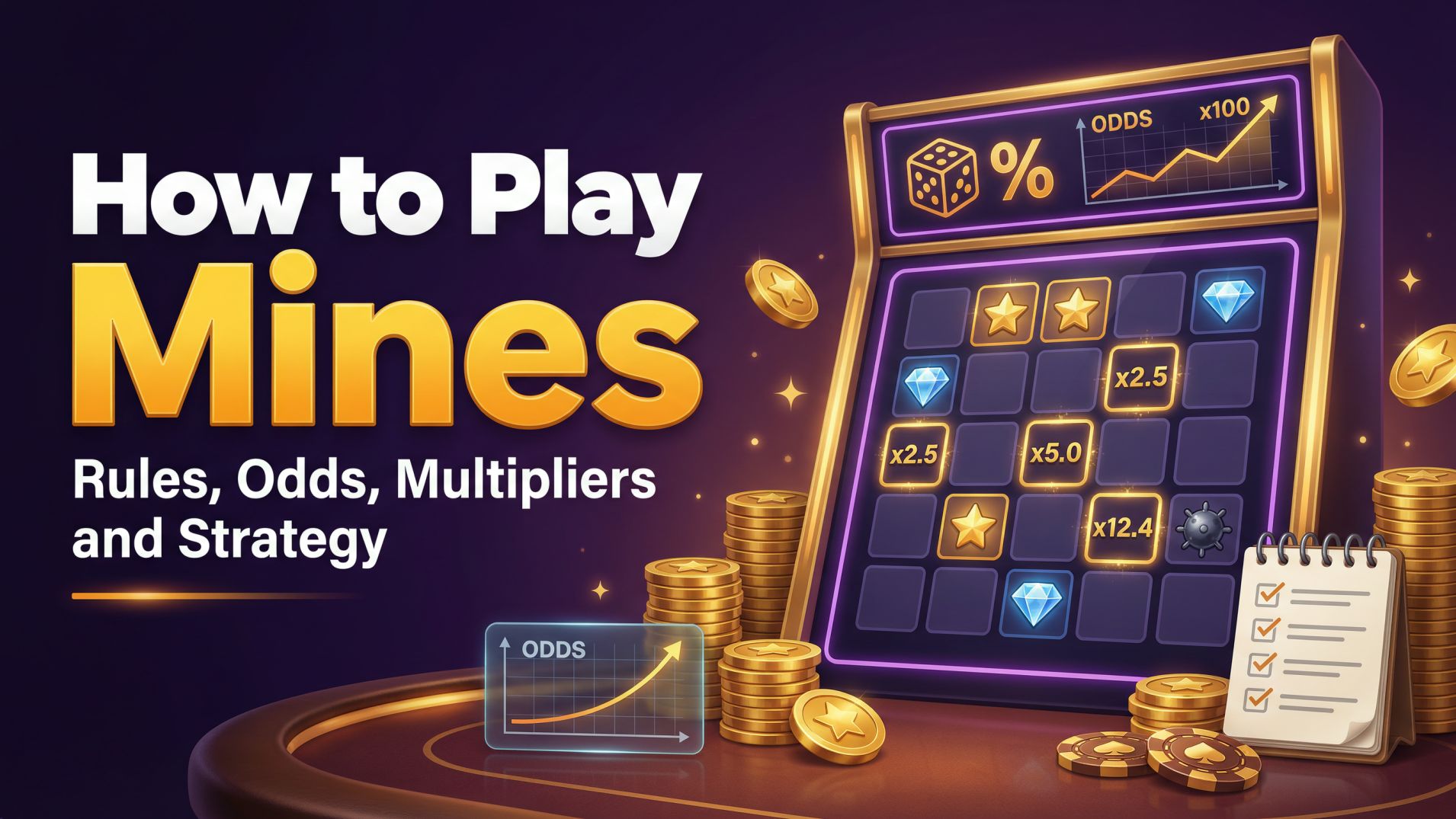
How to play mines comes down to a grid of hidden tiles, a chosen number of mines and one decision after every pick. A player reveals tiles one at a time, each safe tile raises the multiplier, and the round ends at a cash out or a mine. This guide covers the mines game rules, the exact odds per pick, how multipliers are priced and what mines strategy can and cannot change.
NO PURCHASE NECESSARY. A PURCHASE WILL NOT INCREASE YOUR CHANCES OF WINNING. VOID WHERE PROHIBITED BY LAW.
What is the mines game?
Mines is an instant casino game played on a grid of covered tiles, most often 25 tiles in a 5 by 5 square. Before the round, the player sets a stake and a mine count, and the game hides that many mines among the tiles. Every safe tile revealed adds to the multiplier, and revealing a mine ends the round with the stake lost.
The game borrows its idea from Minesweeper, the puzzle that Microsoft first shipped in the Windows Entertainment Pack in 1990 and added to Windows 3.1 in 1992. Casino mines keeps the hidden mines but drops the number clues, so no tile gives any information about its neighbors.
Mines vs classic Minesweeper
The two games share a grid and hidden mines, but they reward different things. The table below shows where they part ways.
Feature | Classic Minesweeper | Casino mines |
Clues | Revealed tiles show how many mines touch them | Revealed tiles show only safe or mine |
Goal | Clear every safe tile on the board | Reveal safe tiles and cash out before a mine |
Role of logic | Deduction solves most of the board | No deduction is possible, because every pick is blind |
Ending | Win by clearing the board, lose on a mine | Cash out at any point after a safe tile, lose on a mine |
Scoring | Time taken to clear the board | Stake multiplied by the current multiplier |
The words you will see in a mines game
Mines games use a short vocabulary, and studios name the same parts in different ways. The table below covers the terms found on most mines screens and help pages.
Term | What it means |
Tile or cell | One covered square on the grid |
Mine or bomb | A hidden tile that ends the round when revealed |
Gem or star | The symbol shown on a safe tile |
Mine count | The number of mines hidden at the start, set by the player in most games |
Multiplier | The figure the stake is multiplied by at the current cash-out point |
Cash out | Ending the round to collect the stake times the current multiplier |
Random pick | An option that reveals a tile chosen by the game |
Autoplay | A preset of tiles, rounds and stop rules that the game repeats |
RTP | Return to player, the share of total stakes a game pays back over the long run |
Provably fair | A method that lets a player check that the mine layout was fixed before the round |
How to play mines in 5 steps
Most mines games follow the same five steps, whatever the studio or grid size. Each game's own help screen sets its grid, its mine range and its multiplier table.
Step 1: Choose the stake for the round
Step 2: Choose the mine count, which sets both the risk per pick and the multiplier per pick
Step 3: Start the round, and the game hides the mines among the tiles
Step 4: Reveal tiles one at a time, and watch the multiplier rise after each safe tile
Step 5: Cash out to collect the stake times the multiplier, or keep picking until a mine ends the round
Steps 2 and 5 hold the real decisions in mines. Step 4 feels like a choice, but every covered tile carries the same chance of hiding a mine, so the tile picked does not change the odds.
Mines odds: the chance of each safe pick
Mines odds follow from simple counting. On a 25-tile grid with 3 mines, the first pick lands on one of 22 safe tiles out of 25, an 88 percent chance. The table below lists the chance of revealing 1, 3, 5 and 10 safe tiles in a row for common mine counts on a 5 by 5 grid.
Mines | 1 safe pick | 3 safe picks | 5 safe picks | 10 safe picks |
1 | 96.0% | 88.0% | 80.0% | 60.0% |
3 | 88.0% | 67.0% | 49.6% | 19.8% |
5 | 80.0% | 49.6% | 29.2% | 5.65% |
10 | 60.0% | 19.8% | 5.65% | 0.092% |
24 | 4.0% | Not possible | Not possible | Not possible |
The table shows a useful symmetry. Three mines and ten picks carry the same 19.8 percent chance as ten mines and three picks, because the counting formula treats mines and picks the same way. Five mines and five picks succeed in 29.2 percent of rounds, a little under one round in three.
Why each pick is riskier than the last
Every safe tile revealed removes a safe tile from the grid but leaves every mine in place. With 5 mines, the first pick is safe 80 percent of the time, but after four safe picks the fifth is safe only 16 times in 21, or 76.2 percent. The chance of the next pick shrinks a little with each tile, and the multiplier grows to match it.
With one mine left among two covered tiles, the next pick is a coin flip. That is why the last few picks on a crowded grid carry the steepest multiplier jumps.
How mines multipliers are calculated
A mines multiplier is the inverse of the chance of reaching that point, scaled down by the game's RTP. A fair multiplier with no house edge would be one divided by the probability, such as 2 times for a 50 percent chance. The game then multiplies that figure by its RTP, so a 97 percent RTP pays 0.97 times the fair figure.
The table below lists the fair multipliers on a 25-tile grid before any house edge. A game's real multipliers sit a few percent below these, and its own help screen lists them.
Mines | After 1 pick | After 3 picks | After 5 picks | After 10 picks |
1 | 1.04x | 1.14x | 1.25x | 1.67x |
3 | 1.14x | 1.49x | 2.02x | 5.05x |
5 | 1.25x | 2.02x | 3.43x | 17.69x |
10 | 1.67x | 5.05x | 17.69x | 1,088.50x |
24 | 25.00x | Not possible | Not possible | Not possible |
At a 97 percent RTP, 10 mines and 5 picks would pay 0.97 times 17.69, or about 17.16 times the stake. At a 98.4 percent RTP, the same point would pay about 17.41 times. The gap between those two figures is the whole difference a game's RTP makes.
Why every cash-out point returns the same
When a game prices every multiplier this way, each cash-out point carries the same expected return. A point reached 29.2 percent of the time pays 3.43 times before the edge, and 29.2 percent of 3.43 equals 1. After the RTP is applied, every combination of mine count and picks returns the game's RTP over the long run.
That fact settles most debates about mines strategy. Choosing 1 mine or 10, or cashing out after 1 pick or 10, changes how often a round pays and how large the payout is. It does not change the share of stakes the game returns over many rounds.
Mines game formats
Studios build mines games in a few formats, and each one keeps the hidden-mine idea while changing the grid. The three formats below cover most titles.
The open 5 by 5 grid
The most common format uses 25 tiles and lets the player pick any covered tile in any order. The player sets the mine count, often anywhere from 1 to 24, though each game's help screen states its own range. The odds and multiplier tables above describe this format.
The ladder or step format
Ladder games turn the grid into rows that the player climbs one at a time. BGaming's Mine Gems uses a 5 by 12 field in which each row hides four gems and one dynamite. Its multiplier rises from 1.23 times on step 1 to 14.28 times on step 12, and BGaming lists its RTP at 98.4 percent.
The numbers follow the same counting rule. Each row is safe four times in five, so the fair multiplier for one step is 1.25 times, and 98.4 percent of that is 1.23 times.
Adjustable field games
Some titles let the player reshape the field itself. BGaming's Minesweeper offers fields from 3 to 15 steps across and 2 to 6 tiles high, with one bomb among the tiles in each column. A taller column means a safer step and a smaller multiplier, while a shorter column means the reverse.
Mines compared with other instant games
Mines belongs to the instant game family, where a round settles in seconds without reels or a dealer. What sets it apart is the decision in the middle of the round. The table below compares mines with three other common instant games.
Game | Choices before the round | Choices during the round | How the round ends |
Mines | Stake and mine count | Pick another tile or cash out | Cash out or a mine |
Plinko | Stake, risk level and rows in many games | None once the ball drops | The ball lands in a slot with a fixed multiplier |
Keno | Stake and the numbers picked | None once the card is confirmed | The draw settles the card against the paytable |
Crash | Stake and an optional auto cash-out point | Cash out before the multiplier stops | Cash out or the crash point |
Mines and crash both let the player stop mid-round, so both reward a cash-out rule set in advance. Plinko and keno settle the round once it starts, so all of the player's choices come before the result.
Provably fair mines
Many online mines games use a provably fair system to show that the mine layout was set before the first pick. The game publishes a hashed server seed before the round, combines it with a client seed and a round counter called a nonce, and places the mines from the result. After the round, it reveals the server seed so the player can check it against the hash.
A provably fair check confirms that the layout did not change after the round started. It does not show the RTP, and it does not make any pick more likely to be safe. Games without this system rely on a certified random number generator instead, and each game's help screen names the method it uses.
Mines strategy, and what it cannot do
No mines strategy changes where the mines are, because the game fixes the layout before the first pick. The decisions that matter are the mine count, the stake, the cash-out point and the number of rounds. Each one shapes the swing of a session, while the RTP sets the long-run return.
Common mines strategy ideas fall into a few groups, such as tile patterns, staking systems and predictor tools. The table below shows what each one actually changes.
Approach | What it changes |
Picking corners, edges or a fixed pattern | Nothing, because every covered tile has the same chance |
Reusing tiles that were safe last round | Nothing, because each round places new mines |
Few mines, early cash out | More frequent small payouts, same long-run return |
Many mines, long runs | Rare large payouts, same long-run return |
Raising the stake after a loss | Only the amount at stake, not the chance of any pick |
Mines predictor apps | Nothing, because the layout is not visible before the round |
Mines predictors and "safe tile" patterns
Apps and videos that claim to predict mine positions cannot see the layout, which stays hidden behind the server seed or the random number generator until the round ends. A provably fair seed reveals the layout only after the round, too late to change a pick. Treat any tool that asks for an account login or a payment in return for predictions with suspicion.
A short record of rounds always shows clusters, such as mines landing in the same corner three rounds running. That spread comes from chance alone and carries no information about the next layout. Reading it as a pattern is the gambler's fallacy.
Session planning for a fast game
A mines round can last a few seconds, so a session can cover hundreds of rounds in an hour. A session plan sets three numbers before the first pick: the balance, the stake per round and the point where play stops. A fixed cash-out rule, such as cashing out after 3 picks on 3 mines, also keeps each round from turning into a chase.
The mine count sets how often a balance drops. At 3 mines and 3 picks, about one round in three ends on a mine, while 10 mines and 3 picks loses about four rounds in five. Time and spending limits, covered in the guide to responsible gameplay, keep a fast game inside the plan.
If play stops feeling like entertainment, the 1-800-GAMBLER helpline (1-800-426-2537) answers by call or text, 24 hours a day. Mines has no minimum number of rounds, so a player can stop at any time.
5 common mines mistakes
The 5 mistakes below come from misreading the odds, the multiplier table or the pace of the game. Each one changes how fast a balance moves without changing the chance of a safe pick.
Pushing one more pick on a crowded grid, where the next pick can be close to a coin flip
Reading safe tiles from the last round as a guide to the next layout
Raising the stake after a mine to win back the balance
Trusting predictor apps that claim to see hidden mines
Running autoplay without a stop rule for losses and rounds
Playing mines free online
Mines sits beside other instant games, such as Plinko and keno, at social and sweepstakes casinos. Betzy, a free-to-play social sweepstakes casino for US players, lists mines titles among its fish and arcade games. They include Mine and Mines by CP Games, Mine Field by Evoplay, and Mine Gems and Minesweeper by BGaming.
In Gold Coin mode these games cost nothing, because Gold Coins carry no monetary value and are never redeemable. The guide to Gold Coins and Sweeps Coins explains how Betzy's two currencies differ.
Common questions
Is mines a game of skill or luck?
Mines is a game of chance, because the mine layout is fixed at random before the first pick and no tile gives a clue. A player's decisions are the mine count, the stake and the cash-out point. Those choices shape how often a round pays and how much, not the long-run return.
How many mines should I choose?
The mine count depends on the kind of results a player wants, because every count returns the same RTP over the long run. Fewer mines, such as 1 to 3, give frequent small multipliers. More mines, such as 10 or above, give larger multipliers that arrive far less often.
Can you predict where the mines are?
No, the mine positions cannot be predicted, because the game fixes them at random before the round and shows them only after it ends. Patterns, past rounds and predictor apps carry no information about the next layout.
What are the odds of hitting a mine on the first pick?
On a 25-tile grid, the chance of hitting a mine on the first pick equals the mine count divided by 25. That works out to 4 percent with 1 mine, 12 percent with 3 mines and 40 percent with 10 mines.
Can you play mines free online?
Yes, social casinos run mines games in free play modes, such as the Gold Coin mode at Betzy, where Gold Coins carry no monetary value. Free play shows how a mine count and a cash-out rule behave over many rounds before any stake of value is involved. Create a free Betzy account to try a 3-mine round in Gold Coin mode.