
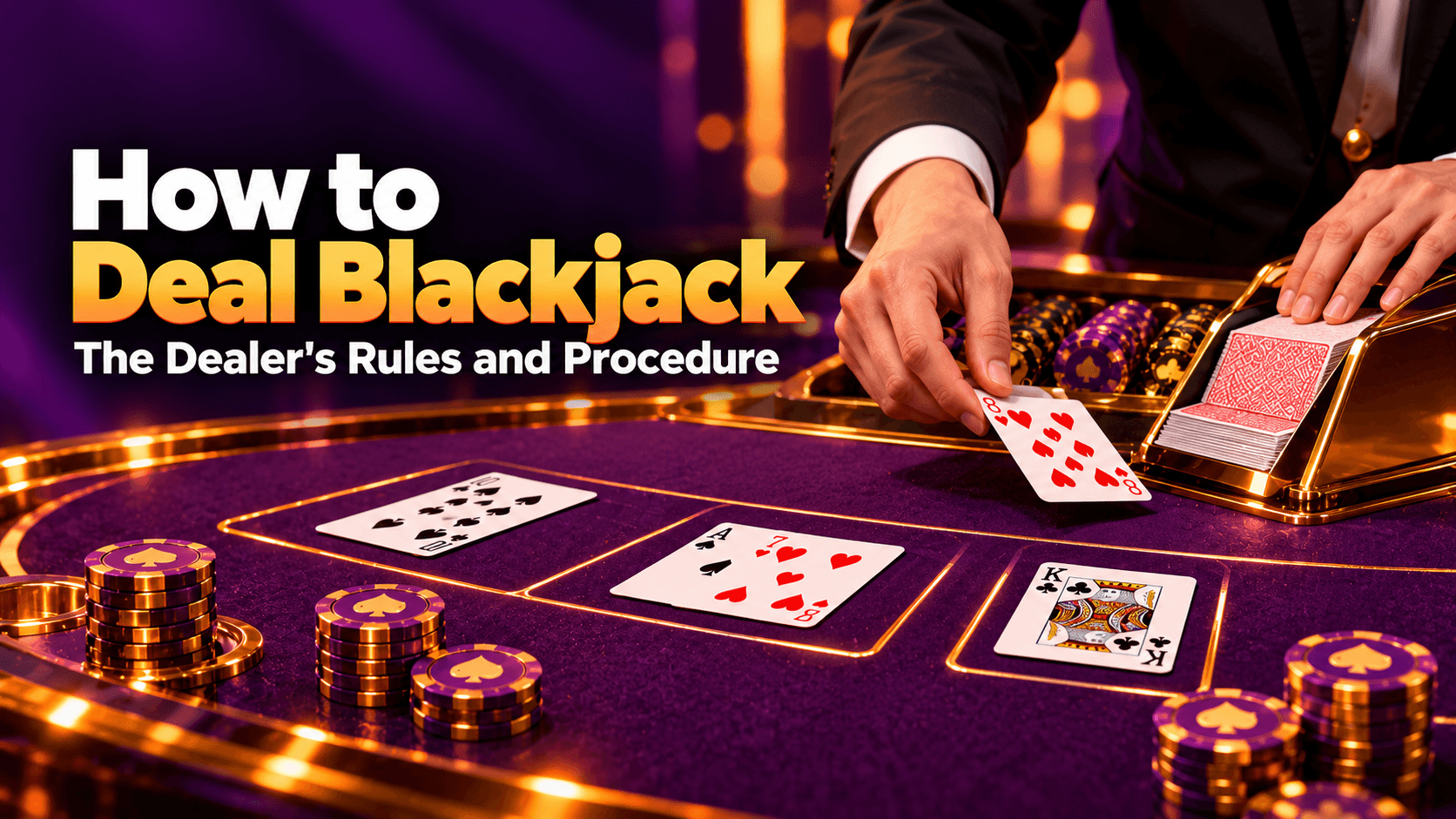
How to Deal Blackjack: Dealer Rules & Procedure
Learn how to deal blackjack: the deal sequence, hole-card rules, when the dealer hits or stands, and how hands are settled.
Dealing blackjack is the procedure of running a hand from the table: taking bets, dealing the cards, following a fixed drawing rule, and settling each player against the dealer's hand. A dealer makes no choices about how to play the hand, which is the defining feature of the role: every action the dealer takes is set by the house rules printed on the table, not by judgment. Learning to deal is therefore learning a fixed sequence rather than a strategy.
Understanding how a dealer works is also the fastest way to understand the game as a player, because the dealer's rule is the one fixed point every decision at the table is measured against. How to deal blackjack comes down to one sequence repeated every hand: bets, the deal, player actions, the dealer's draw, and settlement. For beginners, the key point is that the dealer acts last and to a script, so there is never a decision for the dealer to get right or wrong.
On a sweepstakes platform, you don't deal the hand yourself: a random number generator deals the software tables, and a live dealer deals the streamed tables. Knowing the procedure still helps you read either one. Create a free Betzy account to watch the deal play out in Gold Coin mode, which is entertainment only and costs nothing.
What the dealer is responsible for
The dealer runs the mechanical side of the table and protects the integrity of the game. That means managing the shoe and the chips, dealing in the correct order, enforcing the fixed drawing rule, and paying or collecting each bet accurately. The dealer does not compete with the players in any judgment sense; the house edge comes from procedure, not from the dealer outplaying anyone.
Because the dealer acts to a script, the role rewards consistency and accuracy over any form of card sense. A good deal is a fast, correct, clearly signaled one that every player and camera can follow. The skill is in the handling and the procedure, not in any decision about whether to draw.
Card values the dealer counts
Before you can deal, you need to total hands quickly and correctly, because every hit, stand, and payout depends on the count. Blackjack card values are simple, and suits don't matter at all.
Card | Value |
|---|---|
2 through 10 | Face value |
Jack, Queen, King | 10 |
Ace | 1 or 11, whichever helps the hand without going over 21 |
A hand that counts an ace as 11 is a soft hand, such as ace-6 for a soft 17. A hand with no ace, or with an ace that has to count as 1, is a hard hand. A natural, or blackjack, is an ace plus any 10-value card as the first two cards. When you announce totals, call soft hands by both numbers until the next card settles them, for example "7 or 17."
Blackjack dealer terms you should know
Dealing blackjack carries a vocabulary of its own, covering the equipment, the two card states, and the procedure. The terms below are the ones a dealer uses every hand.
Term | What it means |
|---|---|
Shoe | The box holding the multiple decks the dealer deals from |
Cut card | A colored card placed near the end of the shoe to mark the reshuffle point |
Burn card | The first card removed and discarded after a shuffle |
Up-card | The dealer's face-up card, visible to every player |
Hole card | The dealer's face-down card |
Peek | Checking the hole card for blackjack when the up-card is an ace or ten |
Pitch game | A hand-held one or two-deck game dealt face down to players |
Shoe game | A multi-deck game dealt face up from a shoe |
Toke | A tip a player gives the dealer, often as a bet placed for them |
Pat hand | A dealer total of 17 to 21, which stands |
Setting up the table
A hand of blackjack cannot start until the table is prepared, and the setup is the same whether the game runs on one deck or eight. The dealer shuffles the cards, offers the cut, seats the cut card, and burns the top card before the first hand is dealt. Setup takes four steps:
Shuffle the decks thoroughly, by hand or by an automatic shuffler
Offer the cut to a player, then insert the cut card near the back of the shoe
Load the shoe and burn the first card to the discard tray
Confirm the table rules on the placard, such as the natural payout and the soft-17 rule
How to deal a round, step by step
A round of blackjack follows one fixed order every time, and dealing it correctly is a matter of keeping that order exactly. Bets are taken first, cards are dealt in a set rotation, players act in turn, and only then does the dealer complete the hand. Seven steps take a round from the opening bet to settlement:
Wait for every player to place a bet in the betting box
Deal one card face up to each player in turn, left to right
Deal the dealer's first card face up as the up-card
Deal a second card to each player, then the dealer's hole card face down
Check for naturals, and peek the hole card if the up-card is an ace or a ten
Offer insurance against an ace, then take each player's actions left to right
Complete the dealer's hand to the fixed rule and settle every bet
How the dealer must play the hand
The dealer's hand is played entirely by rule, with no decisions at all, which is the single most important thing to know about dealing. Once every player has acted, the dealer turns over the hole card and draws on any total of 16 or lower, standing on any total of 17 or higher. The dealer never doubles, never splits, and never surrenders.
One variation changes the rule and is printed on the table: the soft 17. On a soft 17, meaning a 17 that includes an ace counted as 11, some tables require the dealer to stand and others require a hit. The hit-on-soft-17 rule works slightly against the player, so a table standing on soft 17 is the better of the two. Beyond that single choice of house rule, the dealer's play is identical on every hand.
Two dealer hands, worked through
Say the dealer shows a 6 and turns over a 10 for a hard 16. The rule says draw on 16 or lower, so the dealer hits and draws a 3 for 19, then stands. Now say the dealer shows an ace and turns over a 6. That's a soft 17. On a stand-on-soft-17 table, the dealer stops there. On a hit-on-soft-17 table, the dealer draws again: a 4 would make 21, while a 9 would turn the hand into a hard 16 (ace counted as 1), so the dealer keeps drawing.
How often the dealer busts
Because the dealer must keep drawing to 17, some up-cards bust far more often than others. With a 4, 5, or 6 showing, the dealer busts roughly 40% of the time in a standard multi-deck game. With a 7 through ace showing, the bust rate falls to roughly a quarter or less. Exact figures vary with the number of decks and the soft-17 rule, but the pattern is why players treat a dealer 5 or 6 as the weakest up-card and a dealer ace or 10 as the strongest.
The hole-card rule: peek or no peek
How the dealer handles the hole card is a rule difference worth understanding, because it decides whether a player can lose an extra stake to a dealer blackjack. In the American deal the dealer takes the hole card immediately and peeks for blackjack when the up-card is an ace or a ten, ending the hand at once if the hole card completes a natural. This protects a player from doubling or splitting into a blackjack that was already there.
In the European deal the dealer takes only the up-card and draws the hole card after every player has acted, with no early peek. A player who doubles or splits against a dealer ace can therefore lose the extra stake to a blackjack that was never visible. The procedure is otherwise the same; the difference is only in when the hole card arrives.
Settling the hands
Settlement is the last step of the deal, and accuracy here is the core of the job. The dealer compares each player's total to their own, pays the winners, collects from the losers, and returns the stake on any tie. The payout schedule is fixed and short, so settling is a matter of applying the same rates every hand.
Outcome | How the dealer settles it |
|---|---|
Player natural, dealer no natural | Pay 3 to 2, or 6 to 5 on a reduced-payout table |
Player total beats the dealer | Pay even money, 1 to 1 |
Dealer busts, player standing | Pay even money, 1 to 1 |
Player total below the dealer | Collect the stake |
Player busts | Collect the stake at once, before the dealer plays |
Tie | Return the stake, a push |
Insurance, dealer has blackjack | Pay the insurance bet 2 to 1 |
The dealer settles from the player on the right to the player on the left, the reverse of the deal, and pays each bet before moving to the next. A bust is collected immediately when it happens, which is why a player who busts loses even if the dealer goes on to bust as well.
Paying naturals and insurance correctly
Most payout mistakes happen on naturals. At 3 to 2, a $10 bet wins $15 and a $5 bet wins $7.50. At 6 to 5, the same $10 bet wins only $12, which is why 3 to 2 tables are better for players. Insurance is a side bet of up to half the original stake, offered when the dealer shows an ace. If the dealer has blackjack, insurance pays 2 to 1. A player can sometimes take "even money," which pays the blackjack 1 to 1 right away instead of risking a push.
Dealing splits, doubles, and surrender
Three player actions change the shape of a hand, and the dealer follows a set procedure for each one. A double down takes one more card and no more; a split turns a pair into two separate hands with a second equal stake; and a surrender, where the table allows it, ends the hand for half the stake. The dealer applies each the same way every time.
Double down: deal exactly one card, often turned sideways, and no further cards
Split: separate the pair into two hands, take a second equal stake, and deal a card to each
Split aces: usually deal one card only to each ace, with no further draw
Surrender: collect half the stake, return the other half, and remove the hand
Pitch games and shoe games
The deal differs between a hand-held pitch game and a shoe game, and the difference is mostly in how the cards are handled. A pitch game uses one or two decks dealt from the dealer's hand, with the players' cards dealt face down and allowed to be picked up. A shoe game uses four to eight decks dealt from a box, with every card face up and the players forbidden from touching them.
The rules of play are identical across both; only the handling and the card count change. A shoe game is the more common form online and in larger rooms, because the face-up deal is easier for cameras to record and harder to tamper with. The drawing rule, the payouts and the player actions stay the same whichever way the cards are dealt.
How to deal blackjack at home
Dealing a friendly game at home uses the same procedure, just with simpler equipment. A few house rules agreed on before the first hand keep the game smooth:
Use one or two standard decks and shuffle well before every new round, or once most of the deck is used
Agree on the rules up front: 3 to 2 for a natural, and whether the dealer stands or hits on soft 17
Deal in the casino order: one card to each player, one to the dealer, then the second round
Rotate the dealer seat every few hands so everyone gets a turn
Play with chips or points for fun, and check local rules before playing for money
Dealer procedure and table protection
Beyond dealing the cards, a dealer follows a set of procedures that keep the game clean and clearly recorded. Each matters because the overhead cameras record gestures and chip movements rather than conversation, so a clear, consistent procedure is what makes a hand reviewable. Five practices cover the core of it:
Announce the action clearly, such as the dealer's total and whether it stands or draws
Keep both hands visible and clear them before and after handling chips
Pay and collect in a fixed order so every bet is accounted for
Place a double or split stake beside the original, never on top of it
Protect the shoe and the discard tray so no card is exposed early
Reading player hand signals
Casino dealers act on hand signals rather than spoken requests, because the overhead cameras record gestures, not voices. In a face-up shoe game, these are the standard signals:
Hit: tap the table behind the cards with a finger
Stand: wave a flat hand side to side over the cards
Double down: place a second equal bet beside the original and hold up one finger
Split: place a second equal bet beside the original and make a V with two fingers
In a face-down pitch game, players scratch the edge of their cards on the felt to hit and slide them under their chips to stand. If a signal is unclear, the dealer should stop and confirm before dealing another card.
How to become a blackjack dealer
Most casino dealers start at a dealer school or an in-house casino training program, where blackjack is usually the first game taught because the procedure is so fixed. Training covers card handling, chip cutting, payout math, and table protection, and new dealers typically finish with an audition on a live table. Dealers who work in a licensed casino generally also need a gaming license or work permit from their state's gaming regulator, which usually includes a background check.
Common mistakes new dealers make
The gap between a smooth deal and a rough one comes from procedure rather than card knowledge. These five cause most of the damage:
Drawing on the dealer hand before every player has finished acting
Forgetting the soft-17 rule printed on the table and standing or hitting wrongly
Missing the hole-card peek on an ace or a ten up-card
Paying a natural at even money instead of the 3 to 2 or 6 to 5 on the placard
Settling in the wrong order and losing track of which bet is paid
How blackjack is dealt at Betzy
You don't deal the hand at Betzy, but understanding the deal makes both forms of the game easier to read. Betzy runs blackjack through the same two currencies as every other game: Gold Coins are entertainment credits with no monetary value, which makes Gold Coin mode free blackjack, and Sweeps Coins are promotional sweepstakes entries worth $1.00 USD each once Redeemable, becoming Redeemable after one complete round. No purchase is ever necessary to play or win. Betzy deals blackjack in two forms: software tables dealt by a random number generator, which applies the drawing rule automatically, and live dealer tables streamed by SA Games, including Deluxe Blackjack D and Deluxe Blackjack M, where a real dealer runs the procedure on camera. Five steps take you from sign-up to watching your first hand:
Create a free account and join the VIP program at Bronze automatically
Open the Table category and pick a blackjack title
Play in Gold Coin mode to watch the deal and the drawing rule at no cost
Open a live SA Games table to see a real dealer run the procedure
Switch to Sweeps Coin mode once the sequence is familiar
Why players choose Betzy for blackjack
Betzy is a free-to-play social sweepstakes platform operated by Texwal LLC, a Wyoming limited liability company, offering casino-style entertainment games rather than gambling. The lobby holds 15+ blackjack titles across software and live dealer tables, so the American peek deal, the European no-peek deal, and the different soft-17 rules can be seen side by side rather than one at a time. Free entries are equal entries: a Sweeps Coin earned through the daily login bonus or a mail-in request carries the same prize eligibility and the same chance of winning as any other, and buying Gold Coins gives no gameplay advantage. Betzy charges no redemption fees, games run on an RNG-certified platform protected by 256-bit encryption, and support is available at support@betzy.fun. Betzy does not hold a gaming license, and none is required to run a sweepstakes promotion.
Playing blackjack responsibly
Blackjack rounds are quick, and a fast game makes a long session easy to fall into without noticing. Betzy keeps four controls inside your account for holding play inside a limit you set: spending limits on Gold Coin purchases by day, week, or month; session time reminders at 30, 60, or 90 minutes; cooling-off periods of 24 hours, 7, 14, or 30 days; and self-exclusion for 6 months, 1 year, 5 years, or permanently. Lowering a spending limit takes effect immediately, while raising one requires a mandatory 48-hour cooling-off period and then must be reconfirmed. Betzy is entertainment and not a way to make money, and any unredeemed Sweeps Coin balance may be forfeited upon self-exclusion. If playing has stopped being fun, help is available 24/7 at 1-800-GAMBLER (1-800-426-2537) by call or text.
Play blackjack at Betzy today
Opening a Betzy account takes about a minute, costs nothing, and enrolls you in the VIP program at Bronze automatically. You can get Sweeps Coins free in four ways: the daily login bonus, in-platform promotions and social giveaways, the refer-a-friend program, and a handwritten mail-in request. Betzy is open to legal U.S. residents age 18 or older, or 21 or older where state law requires it. Residents of Washington, Idaho, and Nevada can't access the platform, and redemptions aren't available to Michigan residents. Sign up free at betzy.fun, open the Table category, and watch a hand dealt in Gold Coin mode before you commit a Sweeps Coin to one.
Frequently asked questions
What are the rules for the dealer in blackjack?
The dealer draws on any total of 16 or lower and stands on any total of 17 or higher, and never doubles, splits, or surrenders. The one variable is the soft 17: some tables make the dealer stand on it and others make the dealer hit, with hit-on-soft-17 working slightly against the player. Every dealer action is fixed by the house rule, not by choice.
Does the dealer hit on 16?
Yes. The dealer must draw on any hard total of 16 or lower, with no discretion to stand. The dealer keeps drawing until the hand reaches 17 or more, or busts by going over 21, at which point the hand is complete.
What is the hole card and the peek?
The hole card is the dealer's face-down card. In the American deal the dealer peeks at it for blackjack when the up-card is an ace or a ten, ending the hand immediately if it completes a natural. In the European deal there is no hole card until players have acted, so there is no early peek.
Can I deal blackjack myself at Betzy?
No. Betzy's software tables are dealt by a random number generator and its live tables are dealt by a real dealer streamed through SA Games, so you play rather than deal. Watching either in Gold Coin mode is the best way to see the procedure run, at no cost.
How does the dealer settle a tie?
A tie, called a push, returns the player's stake with no win or loss. The dealer leaves the bet in place or hands it back, depending on the house procedure, and moves to the next player. A tie on a natural between player and dealer is also a push.
How much does a blackjack natural pay?
A natural pays 3 to 2 on a standard table, so a $10 bet wins $15. Some tables pay only 6 to 5, which turns the same $10 bet into a $12 win. The payout is printed on the table, and if the dealer also has a natural, the hand is a push.
When does the dealer reshuffle?
In a shoe game, the dealer finishes the current round when the cut card comes out, then shuffles before the next one. In a hand-held pitch game, the dealer usually reshuffles after a set number of rounds or once most of the deck has been used.
Do blackjack dealers need a license?
Dealers in licensed casinos generally need a gaming license or work permit issued by their state's gaming regulator, along with a background check. Requirements vary from state to state.