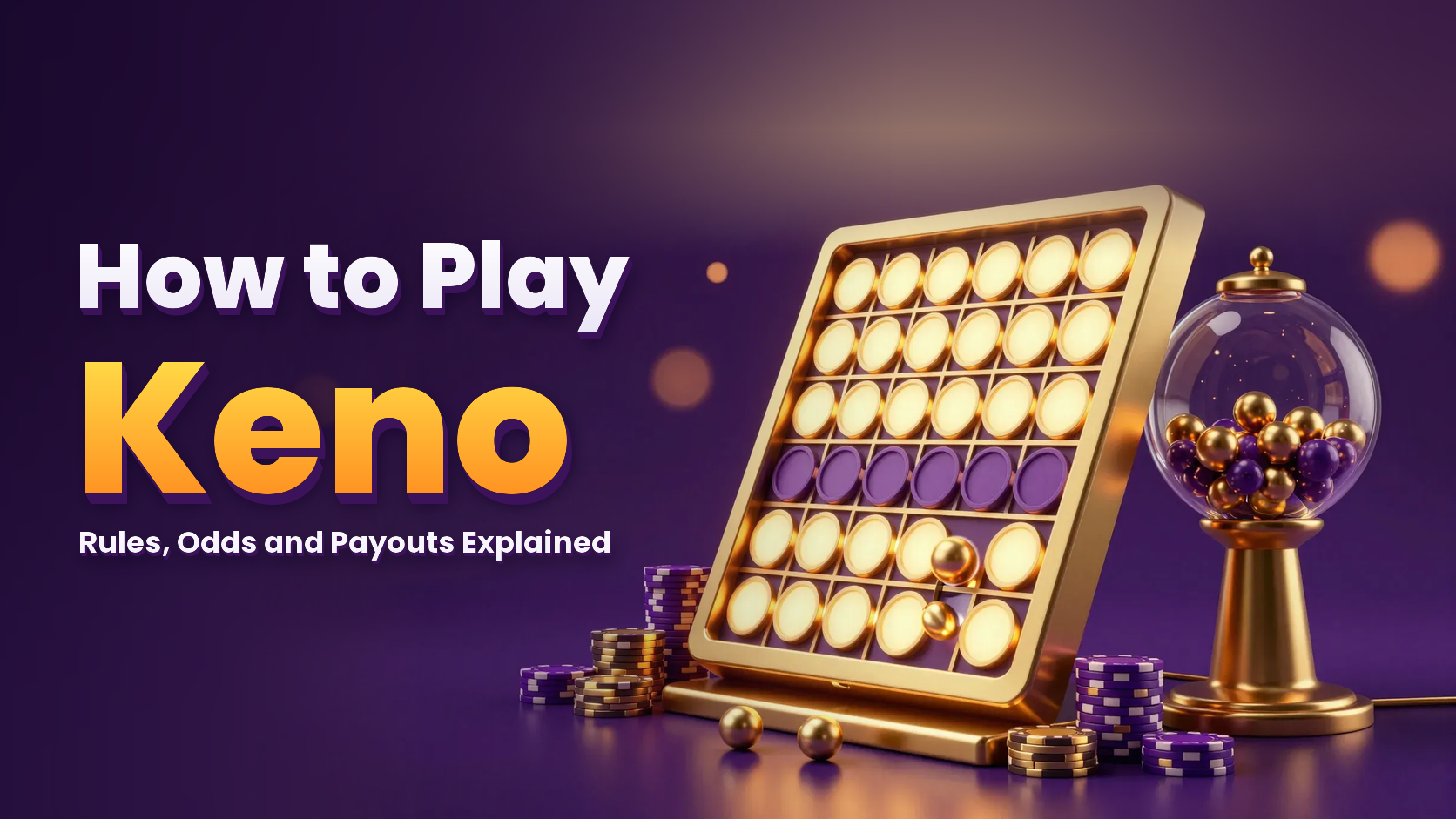
How to Play Keno: Rules, Odds, Payouts and Strategy
How to play keno comes down to a card, a set of picked numbers and one draw. A player marks spots on a keno card, the game draws 20 numbers from 80, and the paytable pays by how many spots it catches. This guide covers the keno rules, the exact keno odds for 1 to 10 spots, keno payouts, house edge and the limits of keno strategy.
How to Play Keno: Rules, Odds and Payouts Explained
Keno is a lottery-style number game in which a player picks numbers and a random draw decides how many of them match. A game settles the moment the draw ends: the system counts the catches, reads the paytable and pays the listed multiple of the stake. Nothing the player does after confirming the card changes the draw.
Keno originated in China, and workers who came to help build the railroads brought it to the United States in the 1800s. Nevada legalized casino games in 1931, but the new law left lotteries illegal, so operators renamed the game "racehorse keno" and presented each number as a horse. The name shortened to keno once the government began taxing off-track horse wagers.
Where keno is played: 4 formats
Keno runs in four main formats, and each one keeps the 80-number board while setting its own pace and spot range. The table below compares lottery keno, casino lounge keno, video keno and online keno.
Format | How the numbers are drawn | Pace and spot range (example) |
|---|---|---|
Lottery keno | A state lottery draws 20 of 80, with results at retailers and in its app | A game every four minutes, 1 to 10 spots (Oregon Lottery) |
Casino lounge keno | Balls or an approved random number generator, lit on keno boards | A game every five minutes, 1 to 15 spots plus a 20-spot ticket (Turning Stone) |
Video keno | A machine's random number generator, with picks made on a touch screen | One game per draw the player starts, 2 to 8 spots per card (Super Times Pay Keno) |
Online keno | A software random number generator on a website or app | One game per confirmed card, range set by each help screen |
Spot ranges differ by venue. Most casinos allow 1 through 20 spots, while some allow only 1 through 10, 12 and 15. The Massachusetts keno regulation sets one to twelve spots on the same 20-of-80 draw.
Inside a casino keno lounge
Casino keno, also called live keno, runs from a keno counter where keno writers process tickets. At Turning Stone Resort Casino in New York, a player marks numbers with an X and writes the spot count and stake on the ticket. Keno runners work throughout the casino and carry tickets to and from the counter.
Turning Stone's lounge rules set three practical points. Players must to check each processed ticket before the game starts, because errors must be corrected before the next game. The last number drawn flashes on the keno boards to end each game, and prizes on a 1 to 20 game multi-race ticket must be claimed within 30 days of the final game.
The keno board and the 20-number draw
A standard keno board holds 80 numbers, printed from 1 to 80. Each game draws 20 numbers from those 80 without replacement, so no number appears twice in one draw. Every spot that lands among the 20 numbers drawn counts as one catch.
Nevada's keno control standards allow two draw methods: a ball system known as rabbit ears, filmed by a dedicated camera, or an approved random number generator. The same standards require casinos to inspect keno balls so that each ball has an equal chance of selection.
Because 20 of 80 numbers are drawn, any single spot has a 20 in 80 chance of being caught, which is exactly 25 percent. That figure holds for every number in every game, such as 7, 42 or 80. A 10-spot card therefore averages 2.5 catches per draw.
The words you will see on a keno card
Keno uses a short vocabulary drawn from lotteries, casino counters and probability. The table below covers the card, the draw and the figures that describe a game's long-run return.
Term | What it means |
|---|---|
Spot | One number marked on the card; a 4-spot card holds four marked numbers |
Catch | A spot that appears among the numbers drawn, also called a hit or a match |
Draw | The 20 numbers selected from 80 to settle a game |
Paytable | The pay schedule that lists what each catch count pays on each card size |
Quick pick | An option that lets the system choose spots at random |
Keno runner | An employee who carries tickets between players and the keno counter |
Multi-race ticket | A ticket that plays the same card over several consecutive games |
Way ticket | A ticket that splits marked numbers into groups, each played as its own card |
Hit rate | The share of games in which a card returns any payout |
RTP | Return to player, the share of total stakes a game pays back over the long run |
House edge | The share of stakes a game keeps over the long run, equal to 100 percent minus the RTP |
How to play keno in 5 steps
Every standard keno game follows the same five steps, whether it runs at a lottery retailer, in a casino lounge or online. Each venue's own rules set the spot range, the minimum stake and the paytable.
Step 1: Choose the number of spots, which decides which paytable column applies
Step 2: Choose the stake per game, the amount the paytable multiplies
Step 3: Mark your keno numbers on the card, or use quick pick
Step 4: Confirm the card, and the game draws 20 numbers from 80
Step 5: Count the catches and read the payout from the paytable
Steps 1 and 2 hold the real decisions in keno. Step 3 feels like a choice, but every number carries the same 25 percent chance, so the spots marked do not change the odds.
Keno odds for 1 to 10 spots
Keno odds follow the hypergeometric model, which counts every way 20 numbers can fall from 80 and how many land on the player's spots. The table below lists the exact probability to catch every spot, the same figure as "one in N" games, and the chance of catching none. All figures assume the standard 80-number board with 20 numbers drawn.
Spots | Chance to catch every spot | About one in | Chance of catching zero |
|---|---|---|---|
1 | 25% | 4 | 75.0% |
2 | 6.01% | 17 | 56.0% |
3 | 1.39% | 72 | 41.7% |
4 | 0.306% | 326 | 30.8% |
5 | 0.0645% | 1,551 | 22.7% |
6 | 0.0129% | 7,753 | 16.7% |
7 | 0.00244% | 40,979 | 12.2% |
8 | 0.000435% | 230,115 | 8.8% |
9 | 0.0000724% | 1,380,688 | 6.4% |
10 | 0.0000112% | 8,911,711 | 4.6% |
Read across a row to see the trade at each card size. A 4-spot card catches all four numbers about once in 326 games, and it misses every spot in 30.8 percent of games. A 10-spot card catches all ten numbers about once in 8,911,711 games, the figure often quoted as one in 8.9 million.
The zero column runs the other way. The chance of catching no spots falls from 75 percent on a 1-spot card to 4.6 percent on a 10-spot card. On a 10-spot card, catching zero is more likely than catching six or more, which happens in about 1.3 percent of games.
Why more spots do not raise your chances
Adding spots raises the average number of catches but does not raise the share of spots that get caught. Each spot keeps the same 25 percent chance, so a 10-spot card averages 2.5 catches and a 4-spot card averages one. What changes is the chance to catch every spot, which shrinks with each spot added.
Each extra spot multiplies the odds against a full catch by a factor of about 4 to 6.5 across this range. Paytables respond by paying more for the rarer results, but a larger top prize does not make that catch any more likely.
How keno payouts and paytables work
Keno payouts come from the paytable, which lists a multiplier for each catch count on each card size. When a game settles, the system multiplies the stake by the figure for the catch count and pays the result. A catch count with no entry on the paytable returns nothing.
Paytables vary by casino and by lottery, so each game's own pay schedule governs its keno payouts. Two games with the same 80-number board can pay different multipliers for the same result, such as 5 catches on a 10-spot card.
The shape of every paytable follows the odds. Frequent results, such as 2 or 3 catches of 10, pay little or nothing. Rare results, such as 9 or 10 of 10, carry the top prize, as the 10-spot frequencies below show.
Catches on a 10-spot card | Probability per game |
|---|---|
0 | 4.58% |
1 | 17.96% |
2 | 29.53% |
3 | 26.74% |
4 | 14.73% |
5 | 5.14% |
6 | 1.15% |
7 | 0.161% |
8 | 0.0135% |
9 | 0.0006% |
10 | 0.0000112% |
The most likely result on a 10-spot card is 2 catches, at 29.5 percent, followed by 3 catches at 26.7 percent. Catching 5 or more happens in about 6.5 percent of games. A 10-spot paytable that starts paying at 5 catches therefore has a hit rate of about one game in 15.
Why the house edge in keno is high
Return to player and house edge describe the same gap from two sides. A game that returns 75 percent of stakes over the long run keeps the other 25 percent as its house edge. Keno sets this gap through its paytable, not through any rule of play.
Published estimates put the keno house edge at less than 4 percent to over 35 percent in online play, and at 20 to 40 percent in in-person casinos. The typical edge for non-slot casino games, such as blackjack and baccarat, sits under 5 percent.
Surveys by the Wizard of Odds show the same pattern. A 2001 survey of Las Vegas live keno found returns of 65 to 80 percent, and a 2012 Laughlin survey found 50 to 74 percent. A 2008 San Diego survey of video keno found returns of 84 to 95 percent. Within each range, the paytable decides which game returns more.
Keno variants and ticket types
Keno variants change how a ticket is built or priced, not how the 20 numbers are drawn. The four types below appear at lottery retailers, casino lounges and video keno machines.
Multi-race tickets
A multi-race ticket plays the same card over several consecutive games at the same stake per game. Turning Stone sells multi-race tickets for 1 to 20 games and Keno To Go tickets for 21 to 999 games. A winning multi-race ticket cannot be redeemed until its series ends, and the Oregon Lottery allows up to 100 games in a row.
Way and combination tickets
A way ticket splits marked numbers into groups and plays each group, and each combination of groups, as its own card. Turning Stone's brochure splits six numbers into three pairs, which play as one 6-spot, three 4-spots and three 2-spots. That ticket plays seven ways, each with its own stake and paytable column.
Turning Stone's 190 Ways of 8 ticket covers the whole board. It splits the 80 numbers into 20 groups of four and pairs every group with every other group, which makes 190 separate 8-spot cards. Each card still keeps the odds in the table above.
Multiplier and bonus options
Multiplier options charge an extra stake for a chance to multiply a prize. The Oregon Lottery's Keno Multiplier costs an extra $1 for every dollar played and multiplies prizes by 1x, 2x, 3x, 5x or 10x. Its published draw rates are 45 percent for 1x and 1 percent for 10x, so the multiplier exceeds 1x in 55 percent of games.
Video keno prices the feature differently. In Super Times Pay Keno, analyzed by the Wizard of Odds, the player adds 20 percent to the wager for a random 2x to 5x multiplier on the base win.
Multi-card video keno
The Wizard of Odds notes that many video keno games allow four cards at the same time and others up to 20. Cards that share more numbers raise the variance, because one draw then hits or misses several cards together.
Keno strategy, and what it cannot do
No keno strategy changes the odds of a draw, because the balls or the random number generator select the 20 numbers independently of any card. Searches for how to win at keno turn up number systems, but the Wizard of Odds states that it makes no difference which numbers a player chooses. The decisions that matter are the venue, the spot count, the stake and the number of games.
The venue matters because paytables set the return, and the Wizard of Odds calls choosing where to play the only skill in keno. Fewer spots, such as 1 to 4, produce frequent small catches, while 8 to 10 spots produce long runs of low catch counts. The stake and the number of games set how fast a balance moves.
Common keno strategy ideas fall into a few groups, such as repeating numbers, marking shapes and chasing losses. The table below sets out what each one actually changes.
Approach | What it changes |
|---|---|
Same numbers every game | Nothing, because each draw is independent of the last |
Patterns, such as a row or a corner block | Nothing, because the draw has no layout |
Quick pick | Nothing, because random spots keep the same 25 percent chance |
Raising the stake after a loss | Only the amount at stake, not the odds |
Changing spot count | The swing and the paytable column, not the chance per number |
Comparing paytables | The long-run return, because the paytable sets the house edge |
Hot and cold numbers
Some players label numbers drawn often as "hot" and numbers drawn rarely as "cold". Each draw is independent of the last, so a number drawn five games in a row keeps the same 20 in 80 chance on the next draw. Reading a streak as a sign of what comes next is the gambler's fallacy.
A short record of draws always shows uneven counts, such as one number appearing four times in ten games while another never appears. That spread comes from chance alone and carries no information about the next draw.
How to play keno within a bankroll and session plan
Keno pace depends on the format. Oregon's lottery keno allows 15 games an hour, and Turning Stone's lounge allows 12. Video and online keno settle a game as soon as the player confirms the card, so a session can run far more games in the same hour.
A session plan sets three numbers before the first draw: the balance, the stake per game and the point where play stops. On a 10-spot card, about 79 percent of games catch 3 or fewer numbers, so long runs of low catch counts are normal. A smaller stake per game covers more draws before a fixed balance runs out.
Free modes at gold coin casinos show these swings at no cost, because the play currency has no monetary value. Limits on time and spending, covered in the guide to responsible gameplay, keep a fast game inside the plan. If play stops feeling like entertainment, the 1-800-GAMBLER helpline (1-800-426-2537) answers by call or text, 24 hours a day.
5 common keno mistakes
The 5 mistakes below come from misreading the odds, the paytable or the pace of the game. Each one changes how fast a balance drops without changing the chance of a catch.
Choosing 9 or 10 spots without checking that a full catch arrives about once in 1.4 million or 8.9 million games
Playing the first paytable available, when the keno house edge ranges from under 4 percent to over 35 percent
Reading hot and cold numbers as a guide to the next draw
Raising the stake after a losing game to chase the balance back
Adding a multiplier option without counting its extra cost per game
Playing keno free online
Online keno also runs at social and sweepstakes casinos, which offer free play currencies. Betzy, a free-to-play social sweepstakes casino for US players, lists two keno titles in its Instant Win category: Keno by CP Games and Book of Keno by Evoplay. Both open in Gold Coin mode, which costs nothing because Gold Coins carry no monetary value and are never redeemable. The guide to Gold Coins and Sweeps Coins explains how the two currencies differ.
Evoplay's own page lists Book of Keno with an RTP of 95.92 to 96.11 percent. It describes play as choosing from ten numbers shown on the book, so its board differs from the 80-number standard. Keno by CP Games sets its pick range and paytable in its help screen, and the odds table above applies only where a game draws 20 numbers from 80.
Common questions
Is there any skill in keno?
Keno involves no skill that changes the draw, because the numbers are drawn independently of any card. A player's decisions are the venue, the spot count, the stake and the number of games. Those choices shape the long-run return, the swing and the pace, not the chance of any catch.
How many numbers should I pick in keno?
The number of spots depends on the kind of results a player wants, because every count carries the same 25 percent chance per number. Fewer spots, such as 1 to 4, catch more often and pay a smaller top prize. More spots, such as 8 to 10, carry a larger top prize that arrives far less often.
What are the odds of hitting all 10 numbers in keno?
On a standard 80-number game with 20 numbers drawn, the odds of hitting all 10 spots are about 1 in 8,911,711. The most likely result on a 10-spot card is 2 catches, at about 29.5 percent.
What is the house edge in keno?
Published estimates put the keno house edge at less than 4 percent to over 35 percent online and 20 to 40 percent in in-person casinos. Each game's paytable sets its own figure, so the edge differs between venues.
Can you play keno free online?
Yes, social casinos run keno in free play modes, such as the Gold Coin mode at Betzy, where Gold Coins carry no monetary value. Free play shows how often a spot count catches before any stake of value is involved. Create a free Betzy account to try a 4-spot or 10-spot keno card in Gold Coin mode.